
If you’re wondering why dark spots are not fading even though you’re using skincare for hyperpigmentation, your serum may not actually be the problem.
Sometimes small mistakes in your routine can slow your progress or cause new marks to appear while the old ones are fading.
Maybe you’re still getting acne, skipping sunscreen or changing products too quickly. Before buying another serum, here are 7 common mistakes worth checking in your routine.
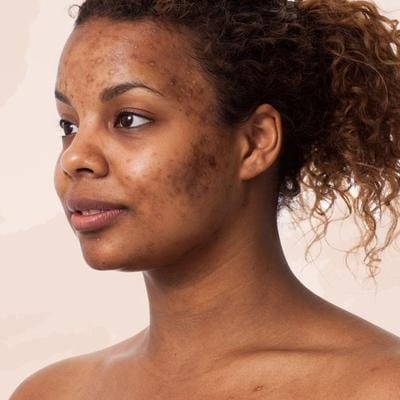
1. You’re Treating the Dark Spots but Not the Cause
One of the biggest mistakes is focusing entirely on fading existing marks while ignoring what’s creating new ones.
For example, if you have active acne, every new inflamed breakout can potentially leave another post-acne mark.
This can make it feel like your dark spot treatment isn’t working because while older marks are gradually improving, new ones continue appearing.
If acne is your main trigger, your routine should address both the breakouts and the pigmentation they leave behind.
If you’re unsure which acne-fighting ingredient to use, read our guide on Salicylic Acid vs Benzoyl Peroxide for Acne in Kenya.
2. You’re Skipping Sunscreen
You can have a great dark spot routine and still struggle to see improvement if you’re not protecting your skin from the sun.
UV exposure can worsen existing pigmentation and make it more difficult for dark marks to improve.
And yes, sunscreen matters for melanin-rich skin too.
Use a broad-spectrum sunscreen during the day and reapply when you’re spending extended periods outdoors.
This is especially important if you’re using ingredients such as retinoids or exfoliating acids in your routine.
3. You’re Using Too Many Actives at Once
More skincare doesn’t necessarily mean faster results.
A routine containing retinol, glycolic acid, salicylic acid, vitamin C, azelaic acid and several brightening serums may sound powerful, but using too many active ingredients can irritate your skin.
And irritation can be particularly counterproductive when you’re trying to manage hyperpigmentation.
Instead of introducing everything at once, build a simple routine and add active ingredients gradually.
Not sure which products can be combined? Read our guide on How to Layer Skincare Actives Correctly in Kenya.
4. Your Dark Spots Are Not Fading Because You Keep Changing Products
This one is common.
You use a dark spot serum for two weeks, don’t see a dramatic difference and switch to something else.
Then another TikTok recommendation appears, and you change your routine again.
The problem is that hyperpigmentation generally doesn’t disappear overnight. How quickly a mark improves can depend on its cause, depth, your skin and whether new pigmentation is still developing.
Constantly switching products can also make it difficult to know what is actually helping or irritating your skin.
Unless a product is causing irritation or another unwanted reaction, give your routine enough time to assess how your skin responds.
5. You’re Damaging Your Skin Barrier
If your face constantly feels tight, burns when you apply products, looks unusually shiny or feels irritated, your skin barrier may need some attention.
Aggressively exfoliating or using strong active ingredients too frequently can contribute to irritation.
When that happens, adding another dark spot serum isn’t necessarily the answer.
Simplify your routine and focus on the basics:
Gentle cleanser → moisturizer → sunscreen
Once your skin feels comfortable again, you can gradually reintroduce your treatment products.
A good dark spot routine shouldn’t require you to sacrifice your skin barrier.
6. You’re Picking or Squeezing Your Pimples
That pimple may be tempting to squeeze, but repeatedly picking at breakouts can increase inflammation and skin injury.
That can contribute to more noticeable post-inflammatory hyperpigmentation once the breakout heals.
Instead, focus on treating the breakout and allowing it to heal with as little unnecessary trauma as possible.
If most of your dark spots appear exactly where you previously had pimples, you’re likely dealing with post-acne hyperpigmentation.
Ingredients such as azelaic acid, niacinamide, tranexamic acid and alpha arbutin are commonly included in routines designed to improve the appearance of uneven pigmentation.
You can learn more in our guide to 8 Proven Skincare Ingredients That Actually Fade Dark Spots.
7. You’re Using the Wrong Ingredient for Your Skin Concern
Not every dark spot needs exactly the same approach.
For example, someone dealing with active acne and post-acne marks may benefit from a different routine than someone whose main concern is persistent uneven pigmentation without breakouts.
This is where understanding your ingredients helps.
Azelaic acid can be particularly useful when you’re dealing with both acne and post-acne marks.
For stubborn uneven pigmentation, tranexamic acid is another ingredient worth considering.
You can also consider niacinamide, which supports a more even-looking complexion and works well in many routines.
Another option is alpha arbutin, commonly used in skincare products targeting uneven pigmentation.
We’ve compared several of these ingredients in our guides on Azelaic Acid vs Tranexamic Acid and Niacinamide vs Azelaic Acid.
The goal isn’t to use every brightening ingredient available. It’s to choose a routine that makes sense for your skin concern and tolerance.
If your dark spots are not fading, take another look at whether the ingredients you’re using actually match the type of pigmentation you’re trying to improve.
What to Do When Your Dark Spots Are Not Fading
Start simple.
You generally need a routine that addresses the cause of the pigmentation, supports your skin barrier and protects your skin from further sun exposure.
For someone dealing with post-acne marks, that might mean:
Morning:
Gentle cleanser → suitable serum → moisturizer → sunscreen
Evening:
Gentle cleanser → targeted treatment → moisturizer
Your exact routine will depend on your skin type, sensitivity, active acne and the products you’re already using.
And remember: consistency usually matters more than throwing five different pigmentation treatments at your skin at once.
Frequently Asked Questions
Final Thoughts
If your dark spots are not fading, don’t immediately assume you need a stronger product.
Look at your entire routine.
Are you still getting new acne? Are you protecting your skin from the sun? Are you constantly switching products? Are you over-exfoliating? Is your skin irritated?
Sometimes the solution isn’t adding another active ingredient. It’s correcting what’s preventing your current routine from working effectively.
Not sure what to use for your dark spots?
At Valentine Aura Luxe, we can help you choose skincare based on your skin type, current routine and concerns.